Cookware Maintenance: Material Science, Technique, and Long-Term Care
The difference between cookware that performs flawlessly for decades and cookware that fails within months lies not in price or brand, but in how it is maintained—how heat, water, chemistry, and storage are managed.
This guide moves beyond cleaning tips to explain the science behind best practices. It covers how materials respond to temperature and chemistry, how failure develops, how to restore and protect surfaces, and when replacement is justified.
Core Principles of Advanced Cookware Care
1. Heat-Flux Management
Always preheat gradually. Proper temperature is where food releases cleanly with minimal oil.
For stainless steel, use the “dancing droplet” test: a droplet that beads and glides means the surface has reached the Leidenfrost point—hot enough to prevent sticking but below oil’s smoke point.
- Bare pans (stainless, carbon steel, cast iron) tolerate high heat.
- Coated pans (non-stick, tinned copper, enamel) require moderate, controlled heat to avoid degradation.
2. Prevent Thermal Shock
Never add cold liquid to a hot pan or place a hot pan on a cold surface. Rapid contraction between layers creates warping, enamel crazing, and eventually delamination in clad pans.
3. Salt Discipline
Salt sitting undissolved on stainless steel can cause pitting corrosion. Always dissolve salt in boiling liquid or add only after ingredients and water are hot.
4. Chemistry Control
- Avoid bleach and strong alkaline cleaners on aluminum and non-stick pans.
- Avoid chlorides on stainless steel.
- Use oxalic-acid-based cleaners (e.g., Bar Keepers Friend) sparingly to remove heat tint and oxidation.
- Always rinse and neutralize afterward with soapy water.
5. Dry Fast, Store Dry
Moisture trapped under rims or around rivets accelerates corrosion.
- Heat-dry carbon steel and cast iron after washing.
- Lightly oil to prevent oxidation.
6. Tooling and Surface Integrity
- Metal utensils are fine for bare stainless, carbon steel, and cast iron.
- Avoid metal on non-stick or enamel.
- When scrubbing brushed stainless, follow the grain to disguise micro-scratches.
Material-Specific Care
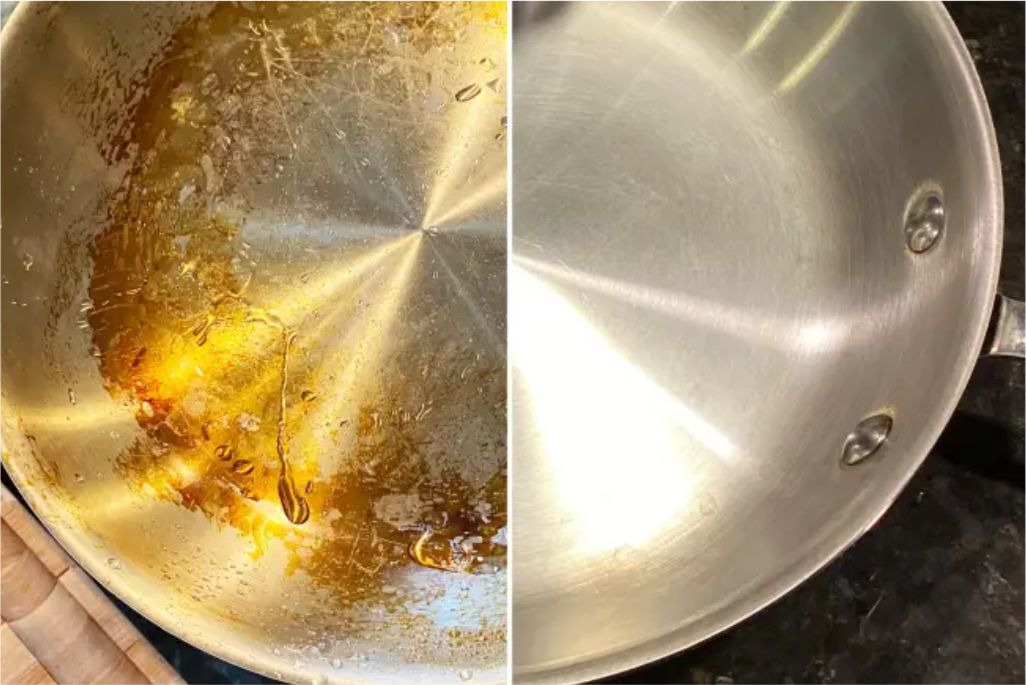
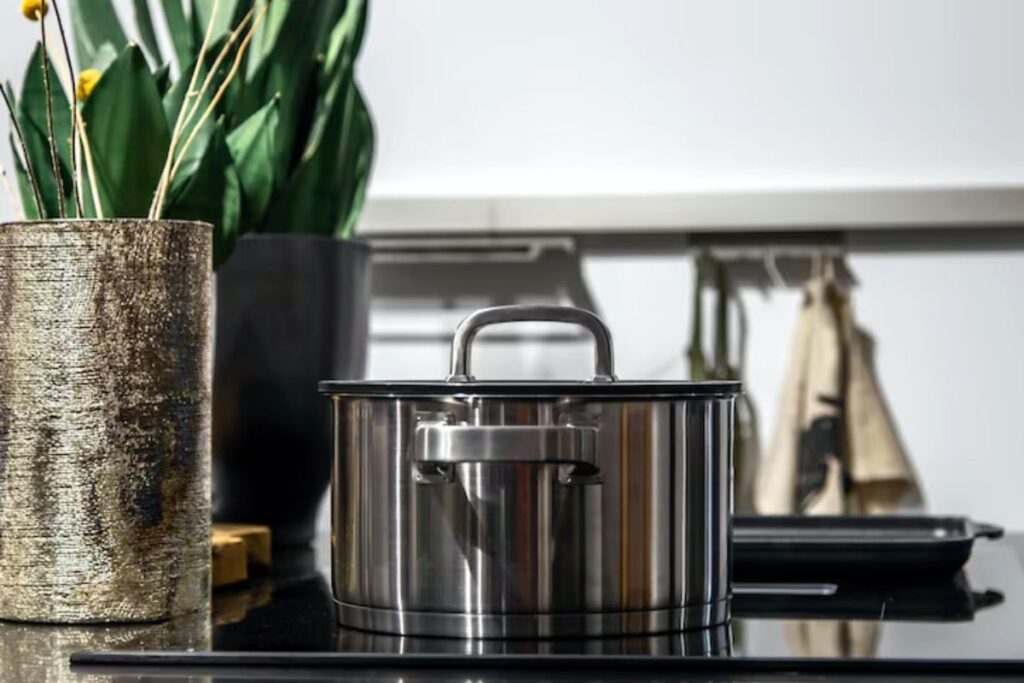
1. Stainless Steel (Clad or Disk-Bottom)
- Material: 304/18-10 stainless for cooking surface; 430 stainless exterior for induction.
- Heat Distribution: Depends on aluminum or copper core thickness.
- Best Practice:
- Preheat using the droplet test.
- Add salt only to boiling water.
- Clean heat tint (blue/brown oxide) with oxalic acid slurry, rinse, and neutralize.
- Deglaze while warm; simmer stuck residue with water and detergent if needed.
- Avoid bleach and long contact with chlorides.
- Maintain polish by scrubbing with the grain.
- Dishwasher use is possible, but hand-washing preserves finish and rivets.
- Failure Modes: Warping from overheating, cladding separation, and loose handles. Severe warps are not repairable.
2. Cast Iron (Bare)
Cast iron’s porous graphite-in-iron matrix holds heat exceptionally. Its protective layer—seasoning—is a polymerized oil film that bonds to the surface.
- Seasoning Oils: Canola, soybean, or grapeseed form strong, flexible layers. Flaxseed polymerizes quickly but may flake if overapplied.
- Seasoning Process: Apply an ultra-thin film of oil, bake at 230–260 °C (450–500 °F) for one hour, cool in oven. Repeat several times.
- Maintenance:
- After each wash, dry over heat and re-oil lightly.
- Wipe warm pan clean; use coarse salt or chain-mail scrubber for stuck bits.
- Avoid soaking in water.
- Cooking Tips: Brief acidic deglazes are fine; avoid long tomato or wine braises—use enameled cast iron instead.
- Restoration: Rust → scrub to bright metal, dry, and re-season. Flaking black film → strip and rebuild. Never grind the base flat—this alters heat contact.
3. Enameled Cast Iron
Vitreous enamel is glass fused to iron: acid-resistant, non-reactive, but brittle.
- Use: Moderate, even heat. Avoid dry preheating.
- Cleaning: Warm soapy soak; nylon brush. Simmer water with baking soda for stains. Use oxygen bleach or mild oxalic acid only occasionally.
- Damage: Interior chips exposing iron require avoiding acids; contact the manufacturer for repair or replacement.
4. Carbon Steel
Thinner and more responsive than cast iron, with a tighter grain.
- Preparation: Remove factory wax, season like cast iron.
- Care: Keep bone-dry; heat-dry after washing.
- Use: Excellent for high-heat searing and stir-frying. Develops a natural non-stick patina with use.
- Restoration: Handle rust exactly as with cast iron—scrub, dry, and re-season.
5. Non-Stick (PTFE or Ceramic/Sol-Gel)
- PTFE (Teflon): Stable to ~260 °C/500 °F; above that, it decomposes. Never preheat empty or broil. Avoid aerosol sprays that carbonize onto the surface.
- Ceramic/Sol-Gel: Harder but less slick; gradually loses non-stick as surface micro-cracks and oil residues polymerize.
- Care:
- Use low–medium heat.
- Wood or silicone utensils only.
- Hand-wash gently.
- Baking soda paste removes residues safely.
- Lifespan:
- PTFE: 2–5 years with care.
- Ceramic: 1–3 years.
- Replace if flaking, peeling, or sticky.
6. Copper (Tinned or Stainless-Lined)
Copper provides unmatched thermal conductivity (≈400 W/m·K).
- Tinned Interior: Superb release but tin melts at ~232 °C/450 °F. Use moderate heat; re-tin when copper shows through.
- Stainless-Lined: More durable—treat as stainless inside, polish outside separately.
- Exterior Care: Clean with copper polish or lemon-salt paste; apply a micro-wax to slow tarnish.
- Avoid Dishwashers: Alkaline detergents attack copper and loosen rivets.
7. Aluminum (Bare or Anodized)
- Hard-Anodized: Oxide layer protects against abrasion and corrosion. Avoid dishwashers—alkaline detergents dull the surface.
- Bare Aluminum: Reactive; don’t store food in it. Hand-wash with mild detergent; never use bleach.
- Issues: Pitting from detergent is permanent; gray marks on glass remove with oxalic-acid cleaner.
8. Glass and Ceramic Cookware
- Composition: Modern soda-lime glass is more shock-sensitive than older borosilicate.
- Use: Avoid direct stovetop unless rated. Never add cold liquid to hot glass.
- Cleaning: Soak and use nylon scrapers; peroxide-based cleaners help with baked residues.
Troubleshooting and Quick Fixes
|
Problem |
Likely Cause |
Remedy |
|
Food sticks on stainless |
Pan too cool or dirty |
Preheat to droplet stage; add oil, then food |
|
Blue/brown tint |
Heat oxidation |
Clean with oxalic acid |
|
White film |
Mineral deposits |
Boil vinegar–water mix, rinse |
|
Burnt residue |
Caramelized sugars or oils |
Simmer with water and detergent; scrub with BKF |
|
Rust on cast iron |
Moisture after washing |
Scrub to bright metal, heat-dry, re-season |
|
Non-stick sticky surface |
Baked oil film |
Clean with baking soda paste; if flaking, replace |
|
Warped pan |
Overheating or thermal shock |
Not repairable—replace |
9. Storage and Handling
- Stacking: Place felt or paper between pans to prevent scratches.
- Hanging: Use strong anchors; distribute weight evenly.
- Moisture Control: Always store pans dry. Oil cast iron lightly before storage.
- Hardware: Inspect handles and rivets periodically. Use medium thread-locker if screws loosen.
10. Induction and Cook-Top Nuances
- Compatibility: Requires ferromagnetic base (cast iron, carbon steel, or 430 stainless).
- Noise/Buzz: Caused by thin magnetic layers; reduce power or use heavier pans.
- Flatness: Essential for efficiency. Warped pans cause uneven heating.
- Power Ramp: Induction heats fast—raise temperature gradually to prevent overshoot.
11. Advanced Restoration Methods (Safety First)
- Lye Bath: Removes baked-on polymers from cast iron; use gloves, eye protection, and neutralize afterward.
- Citric Acid Bath: Quick derusting; monitor carefully to avoid etching fresh metal.
- Electrolysis: Safest for deep rust; preserves base metal.
- Re-Tinning Copper: Only by professional tinners—well-made copper can last indefinitely.
12. Safety and Replacement Thresholds
- Temperature Limits:
- PTFE: ≤ 260 °C / 500 °F
- Tin: ≤ 230 °C / 450 °F
- Phenolic handles: ≤ 175 °C / 350 °F
- Silicone: ≤ 250 °C / 480 °F
- Oil Fires: Smother with lid or baking soda—never water. Keep a Class K or ABC extinguisher nearby.
- Chemical Cautions: Never mix acids and bleach; rinse oxalic acid thoroughly.
- When to Replace:
- Non-stick: peeling or scratched
- Stainless: severe warp or cladding failure
- Cast iron/carbon steel: cracked (rare)
- Enamel: deep interior chips exposing iron
- Copper: re-tin when bare copper shows
13. Glass and Ceramic Cookware
- Composition: Modern soda-lime glass is more shock-sensitive than older borosilicate.
- Use: Avoid direct stovetop unless rated. Never add cold liquid to hot glass.
- Cleaning: Soak and use nylon scrapers; peroxide-based cleaners help with baked residues.
14. Performance Optimization Tips
- Adhesion Control: Dry proteins; salt just before cooking; use a thin continuous oil film.
- Choice of Fat: For seasoning—high unsaturation oils; for searing—clarified butter or high-smoke-point oils.
- Burner Match: Match burner size to pan base to prevent rim overheating.
- Thermal Inertia: Thicker bases maintain stable temperature; sear in smaller batches in thin pans.
- Post-Wash Heat Dry: One to two minutes on low heat removes hidden moisture and prevents rust.
15. Performance Optimization Tips
- Adhesion Control: Dry proteins; salt just before cooking; use a thin continuous oil film.
- Choice of Fat: For seasoning—high unsaturation oils; for searing—clarified butter or high-smoke-point oils.
- Burner Match: Match burner size to pan base to prevent rim overheating.
- Thermal Inertia: Thicker bases maintain stable temperature; sear in smaller batches in thin pans.
- Post-Wash Heat Dry: One to two minutes on low heat removes hidden moisture and prevents rust.
16. Routine Care
Daily
- Preheat gradually; confirm readiness.
- Use proper utensils.
- Deglaze or soak while warm.
- Dry completely and oil as needed.
Weekly / Monthly
- Polish stainless and copper surfaces.
- Inspect and tighten handles.
- Refresh seasoning with a thin oil coat after deep cleaning.
Final Thought
Cookware longevity is a matter of respecting material limits. Every alloy, coating, and finish is engineered with tolerances in mind. By mastering the interplay between heat, chemistry, and time, you ensure your cookware not only performs better but becomes seasoned heirloom, stable, and ready for another generation.